
Consumer packaged goods brands constantly struggle with one key challenge: keeping products well-displayed, properly stocked, and effectively promoted at the point of sale, while also capturing orders and managing field teams smoothly.
Many retail execution tools only handle the audit side. They leave order capture, delivery coordination, and follow-ups to separate systems entirely. This creates data gaps, slows down reorders, and forces teams to switch between multiple apps while out in the field.
The platforms below were chosen for their strong ability to connect in-store visibility with real sales workflows. They also bring proven expertise in CPG operations and stay transparent about pricing and implementation. Here’s how the top 4 compare at a glance.
Tools for In-Store Execution and Distribution
Not all retail execution software is built for the full workflow. Some stop at shelf audits, forcing your team to switch apps just to capture a reorder. Others bundle retail execution as an afterthought inside a massive enterprise suite.
Below, we break down four platforms that actually connect in-store visibility to distribution workflows—starting with the only one designed from day one to unify audits, orders, and DSD routing in a single mobile app.
SimplyDepo
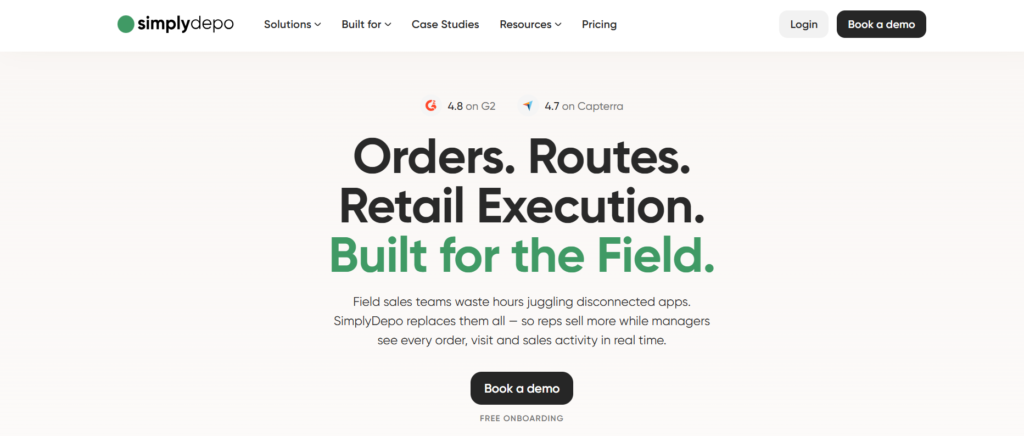
SimplyDepo is the only platform that brings shelf audits, order capture, and DSD workflows together inside one mobile app built specifically for CPG teams.
It serves as a mobile-first retail execution solution for CPG brands and distributors. The platform combines shelf audits, planogram compliance, photo reporting, in-store demos, and visit tracking with full field sales capabilities — including order capture, DSD route planning, van sales, invoicing, and direct sync with QuickBooks and Shopify.
Founded in 2022, SimplyDepo fills a noticeable gap that most other tools overlook: the awkward handoff between merchandising and ordering. A single rep can check the shelf, take photos, confirm planogram compliance, capture a reorder, plan the next day’s route, and sync everything to accounting — all without needing an internet connection.
The platform stays focused exclusively on consumer packaged goods workflows. It also delivers AI-driven insights that help predict demand, spot strong and weak SKUs, optimize delivery routes, and catch compliance issues in real time.
This makes it especially useful for SMB and mid-market distributors in the US and Canada who want to replace several separate tools with one smooth workflow.
Core capabilities:
| Feature | Description |
| B2B Order Management | Quotes, drafts, invoicing, returns |
| Retail Execution | Shelf audits, planogram compliance, photo logging |
| Route Planning | Optimization for DSD and van sales |
| Native integrations | QuickBooks and Shopify sync included |
Pricing starts at $89/rep/month with no annual contracts, no setup fees, and a 30-day free trial that includes team training. Teams can be operational in days rather than months, a stark contrast to enterprise implementations that stretch across quarters.
Limitation: Geographic scope is limited to North America. Brands requiring multi-region, multi-currency deployments across EMEA or APAC will need to look elsewhere.
Who Should Still Choose SimplyDepo
SimplyDepo is a strong fit for SMB and mid-market CPG brands and distributors operating in the US or Canada that rely on in-store visits. Teams that need to connect shelf audits, order capture, and delivery workflows in one system will benefit the most.
It is especially useful for companies that want to replace multiple tools (audit app + order app + spreadsheets) with a single mobile workflow and avoid enterprise-level pricing or long implementations.
SPOTIO
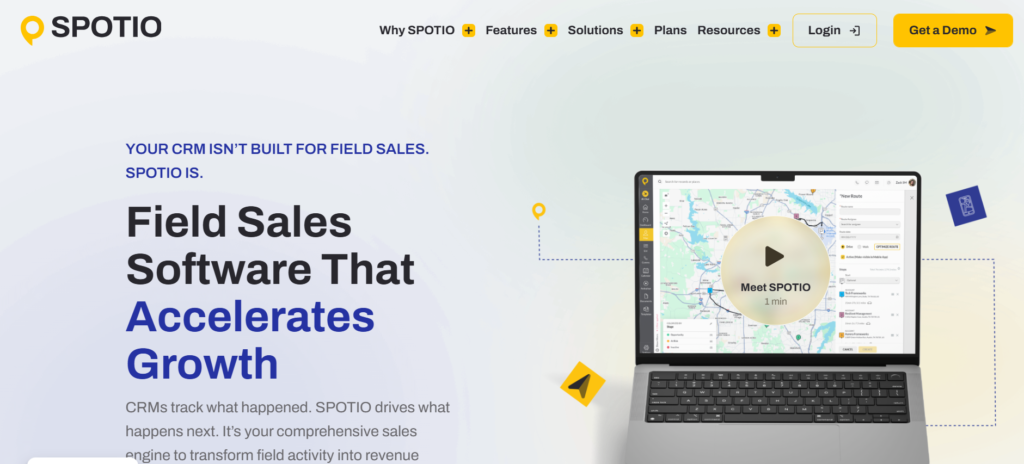
SPOTIO is a territory-based field sales platform. It concentrates on activity tracking and pipeline management, not order capture or retail execution.
Founded in 2014, it helps sales teams handle territory selling more efficiently. Reps can manage leads, map territories, and optimize routes to plan visits based on real location and opportunity data.
The platform offers real-time activity tracking so managers can monitor performance and see how daily efforts turn into pipeline progress. It also includes analytics, leaderboards, coaching tools, and automation for follow-ups and data entry.
AI features add extra support for planning and insights. SPOTIO integrates well with CRMs and other sales tools to keep data consistent.
Primary use cases:
- Territory mapping and route optimization for field reps
- Lead management and prospecting workflow automation
- Activity tracking and pipeline visibility for managers
- Performance analytics and coaching tools for sales teams
- B2B and B2C sales teams in construction, telecom, and business services
Limitation: Users report connectivity issues, glitches, and weaker reporting in some reviews. It is not built for order processing, DSD, or retail execution. (G2 and Capterra reviews)
Who Should Still Choose SPOTIO
SPOTIO is a strong fit for B2B and B2C field sales teams that rely on territory-based selling. Companies in industries such as construction, telecom, and business services that need to track activity, optimize routes, and manage pipelines will find it useful.
It works best when the focus is on increasing sales productivity and visibility rather than handling orders or in-store operations.
Repsly
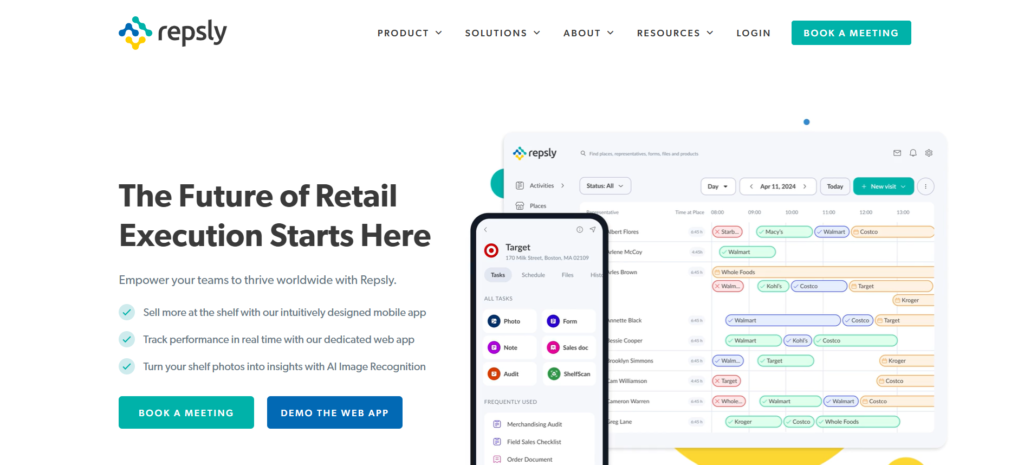
Repsly stands out in retail execution. It focuses heavily on audit accuracy and smart AI shelf analysis instead of combining everything with order management.
Since 2008, the platform has been helping CPG brands and merchandising teams understand exactly how their products are performing in stores. Field reps use it to gather structured data during visits, which then gets turned into useful insights. It’s a popular choice for running shelf audits, checking planogram compliance, and keeping an eye on product availability.
Its AI image recognition tool is particularly impressive. It scans shelf photos to identify items and measure compliance, saving teams a lot of manual effort while improving accuracy.
Repsly also handles field team coordination with features like visit tracking, territory planning, and task assignment. Managers can easily keep track of everything through real-time web dashboards.
Pros:
- Multi-decade experience focused purely on retail execution
- ShelfScan AI that cuts manual reporting time
- Strong dashboards that give managers clear visibility
Limitation: Users report that back-office functions can feel clunky and poorly organized, along with occasional app logouts, stability problems, and usability issues in certain workflows. (G2 reviews)
Who Should Still Choose Repsly
Repsly is better suited for mid-sized and enterprise CPG organizations that prioritize retail execution visibility over sales or distribution workflows. Teams focused on shelf audits, planogram compliance, and photo-based reporting—especially those working with merchandising agencies—will find its capabilities aligned with their needs.
It is a good option when audit accuracy and in-store insights matter more than integrating order capture or DSD operations.
Pepperi
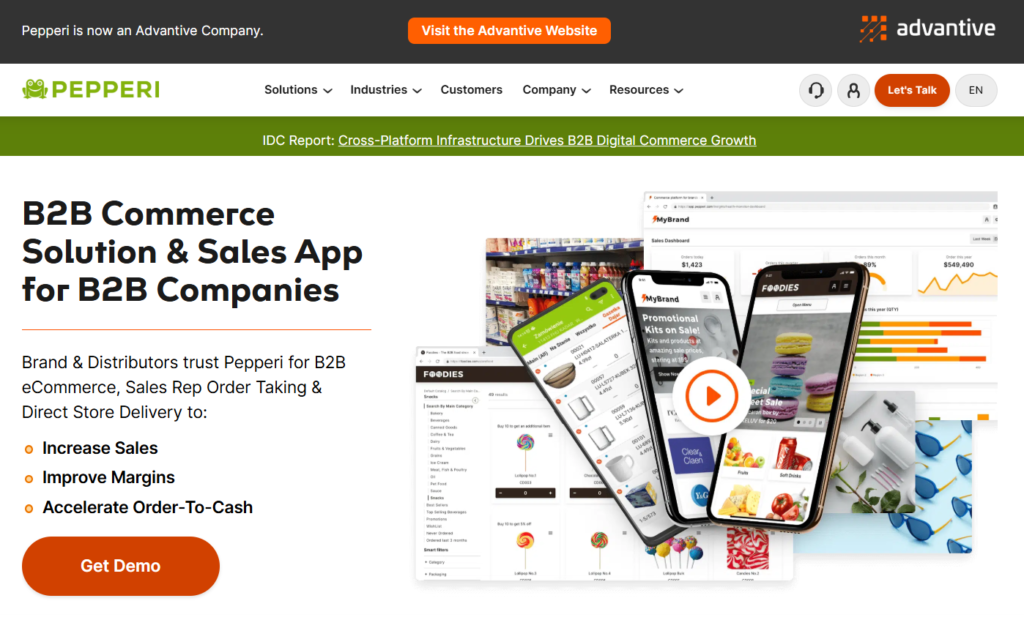
Pepperi is an enterprise-grade B2B commerce suite that integrates retail execution into a full order-to-cash platform.
Founded in 2012, Pepperi brings together eCommerce, field sales, order management, and retail execution in one unified system. It was built for brands and wholesale distributors who want to manage different parts of their sales and distribution operations without switching between multiple tools.
The platform also includes additional modules for trade promotions, mobile CRM, inside sales, and customer support. This allows companies to handle the entire process — from the first customer contact through fulfillment and invoicing.
Retail execution features like in-store activity tracking and merchandising support are available, but they sit within the larger enterprise system rather than being the main focus.
Limitation: Users report higher costs compared to SMB-focused tools, along with the need for setup support or partner involvement, and some mention customer support and billing issues. (Capterra reviews)
Who Should Still Choose Pepperi
Pepperi is more appropriate for mid-market and enterprise distributors that need a full B2B commerce ecosystem. Companies with complex ERP integrations, multi-region operations, and layered sales processes will benefit from its broad functionality.
It is a strong choice when the priority is managing the entire order-to-cash lifecycle across multiple channels, even if it requires a higher cost and longer implementation.
Mistakes to Avoid When Choosing Software
Even with the right shortlist, CPG leaders often make predictable errors that lead to low adoption, workflow gaps, and hidden costs. Here’s what to watch for:
1. Choosing a retail execution tool without order capture
Many platforms stop at shelf audits and photo compliance. If your field rep identifies a low-stock situation but can’t capture a reorder within the same app, you’ve just created a data handoff delay. That gap means lost sales, manual data entry, and missed reorder windows.
Always verify that audit insights lead directly to an order—without switching apps.
2. Ignoring offline functionality
Retail basements, back stockrooms, and rural delivery routes often have poor connectivity. If your chosen software requires continuous internet access, your team will waste time finding a signal or lose work entirely.
Demand offline-capable data capture and auto-sync when connectivity returns.
3. Overlooking DSD and route planning needs
Direct-store-delivery workflows involve inventory on the truck, van sales, and sequenced stops. Generic field sales tools don’t handle load sheets, invoice generation at the tailgate, or dynamic route re-optimization. If you run DSD, don’t buy a pure activity-tracker—you’ll outgrow it in weeks.
4. Underestimating implementation time
“Enterprise-ready” can mean 3–6 months of setup, custom integration work, and consulting fees. For SMB and mid-market CPG teams, that means stalled operations and delayed ROI.
Ask for a clear, documented timeline and a trial period where your actual team runs a real store visit and order before signing.
5. Falling for published “starting at” pricing without asking about overages
Some platforms charge extra per additional user, per photo upload, per API call, or per integration. Others require an annual commitment and setup fees that aren’t in the marketing materials.
Get a written quote that includes all active users, expected data volume, and integration scope—then compare month-to-month vs annual terms.
6. Buying for features you don’t need
A full enterprise commerce suite (eCommerce, CRM, trade promotions, inside sales) is overkill if your real problem is shelf compliance and reorder capture. Complexity creates training costs and abandoned logins.
Start with the workflow that hurts the most: audit, order, or route. Add depth later.
7. Ignoring geographic scope
A platform perfect for North America may lack multi-currency, local tax rules, or language support for EMEA or APAC. Check your current and next 18-month markets before committing.
Conclusion
At the end of the day, the best software is the one that fits your real daily workflow. When field teams finish an audit but still have to switch apps to place an order, that’s a clear sign it’s not the right fit.
Make offline access a priority, along with transparent pricing and rollout schedules that actually match your team size. Skip platforms overloaded with features you’ll never use, and always confirm solid geographic coverage before you sign.